Multiple Postsecularity: Reinstitutionalization of Traditional Religions and the Acute Need for Empirical Research
DOI:
https://doi.org/10.14515/monitoring.2026.3.3414Keywords:
postsecularity, new epistemology, modernization, globalization, mediatization, transformation of Russian society, applied sociological research, author narrativesAbstract
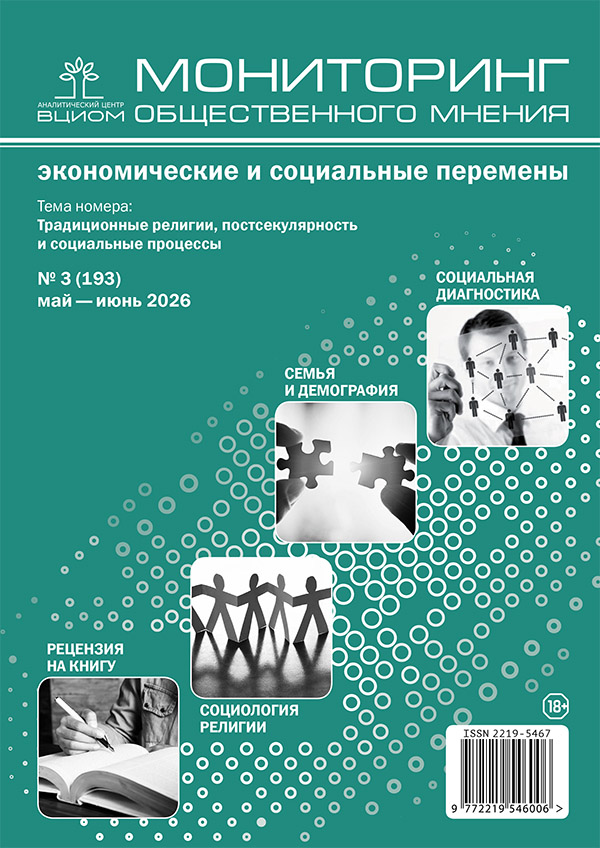
The postsecular turn in Russian society is clearly visible in the reinstitutionalization of the entire range of communicative practices against the backdrop of such transformative processes as modernization, globalization, and mediatization. The visible outcome of these changes is a multiplicity of discourses across various social subsystems concerning the institutional meanings of tradition and innovation. These discourses draw on the semantic and symbolic formations of traditional religions. The difficulty of researching the postsecular mode of reinstitutionalization of traditional religions lies in its novelty and the sharply polarized reception it receives, both among secularized publics and in academic debates. The central theme of this article is a reflection on postsecularity as either a new epistemology or a descriptive framework for sociological research into the current configuration and interrelations of institutional systems—politics, economics, religion, education, law, science, and others. The author treats postsecularity as an epiphenomenon of the transformations of modern society brought about by modernization, globalization, and mediatization. Postsecularity presents itself as a cacophony of secular and religious narratives that intertwine or confront each other in the public sphere. It is marked both by a conflictual dialogue between the secular and the religious and by new sites of convergence and overlap between them—such as the emergence of religious NGOs operating within secular subsystems, and the expanding hybrid media narratives that combine the symbolic codes of different subsystems. Postsecularity does not negate or erase secular reality; it coexists with it. The author also offers a kind of guide to the themes and issues addressed in the articles of this special issue. The article includes the contributors’ own accounts of the sources of their personal inspiration and motivation for researching complex, multiple postsecularity.
Acknowledgments. This article was prepared with the financial support of the Russian Science Foundation, grant No 26-18-00579, https://rscf.ru/project/26-18-00579/.
References
Кырлежев А.И. Религиозное и светское: Постсекулярноcть и драматика модерна. М.: Новое литературное обозрение, 2026.
Kyrlezhev A.I. (2026) The Religious and the Secular: Post-Secularity and the Drama of Modernity. Moscow: New Literary Observer. (In Russ.)
Латур Б. «Не произноси имени Божьего всуе» — нечто вроде проповеди о затруднениях религиозной речи // Логос. 2023. Т. 33. № 6. С. 144—188. https://www.doi.org/10.17323/0869-5377-2023-6-143-185.
Latour B. (2023) “Do Not Take the Name of God in Vain” — Something Like a Sermon on the Difficulties of Religious Speech. Logos. Vol. 33. No. 6. P. 144–188. (In Russ.) https://www.doi.org/10.17323/0869-5377-2023-6-143-185.
Узланер Д. А. От секулярной современности к «множественным»: социальная теория о соотношении религии и современности // Государство, религия, Церковь в России и за рубежом. 2012. № 1. С. 8-32.
Uzlaner D.A. (2012) From Secular Modernity to ‘Multiple’ Ones: Social Theory on the Relationship between Religion and Modernity. State, Religion, Church in Russia and Abroad. No. 1. P. 8–32. (In Russ.)
Узланер Д. А. Постсекулярный поворот: как мыслить о религии в XXI веке. М.: Издательство Института Гайдара, 2020.
Uzlaner D.A. (2020) The Post-Secular Turn: How to Think about Religion in the 21st Century. Moscow: Gaidar Institute Press. 410 p. (In Russ.)
Хабермас Ю. Между натурализмом и религией. Философские статьи. М.: Весь мир, 2011.
Habermas J. (2011) Between Naturalism and Religion: Philosophical Essays. Moscow: Ves Mir. (In Russ.)
Эйзенштадт Ш. Новые религиозные констелляции в структурах современной глобализации и цивилизационная трансформация // Государство, религия, Церковь в России и за рубежом. 2012. № 1. С. 33-56.
Eisenstadt Sh.N. (2012) New Religious Constellations in the Frameworks of Contemporary Globalization and Civilizational Transformation. State, Religion, Church in Russia and Abroad. No. 1. P. 33–56. (In Russ.)
Beaumont J., Eder K., Mendieta E. (2018) Reflexive secularization? Concepts, processes and antagonisms of postsecularity. European Journal of Social Theory. Vol. 22. No. 1. P. 1—19. https://doi.org/10.1177/1368431018813769.
Cloke P., Baker C., Sutherland C., Williams A. (2019) Geographies of Postsecularity: Re-envisioning Politics, Subjectivity and Ethics. Abingdon, Oxon; New York: Routledge. 240 p. DOI: https://doi.org/10.4324/9781315670614.
Latour B. (2019) Beyond Belief: Religion as the ‘Dynamite of the People’. In: Beaumont J. (ed.). The Routledge Handbook of Postsecularity. London: Routledge. P. 27–38. DOI: https://doi.org/10.4324/9781315307831.
Downloads
Published
How to Cite
Issue
Section
License
Copyright (c) 2026 Елена Александровна Островская

This work is licensed under a Creative Commons Attribution-NonCommercial-ShareAlike 4.0 International License.